
What to Do When You Don’t Have a Single "Dream Job"?
It’s an ordinary Tuesday afternoon, and you are sitting in class when the question drops. Maybe it comes from a well-meaning guidance counsellors, a stressed-out parent, or an invasive relative at a family dinner.
"So, what do you want to do with the rest of your life?"
Instantly, your stomach does a flip. You look around, and it feels like everyone else has their life perfectly mapped out. Sarah has known she wanted to be a paediatric neurosurgeon since the sixth grade. Marcus is already coding apps and tracking his admissions chances at MIT.
And you? You like video games, but you don't necessarily want to spend fourteen hours a day debugging code. You’re decent at history, you enjoy editing videos for TikTok, and you like graphic design but none of these feels like a burning, lifelong "passion."
If you don't have a definitive "dream job" at sixteen, seventeen, or eighteen years old, here is a piece of advice that might shock you: Good. You are actually in a better position than people who do.
The idea that every human being is born with a single, magical "passion" that translates perfectly into a 40-year corporate career is a myth. It puts an impossible amount of pressure on high school students, and frankly, it doesn't match how the modern world works.
It’s time to ditch the pressure of finding your passion and adopt a much more realistic, lower-stress strategy: The Anti-Passion Approach.
Share: 


The Problem with the "Follow Your Passion" Narrative
We’ve been fed the "follow your passion" line since kindergarten. It sounds beautiful on an inspirational poster, but in reality, it causes two massive problems for high school students.
1. Passions Change (And That's Normal)
Think about who you were in the seventh grade. The clothes you wore, the music you listened to, the people you hung out with would you let that version of you choose what you wear today? Probably not. So why do we expect your current self to lock in a career path that your 30-year-old self is stuck with? Your brain is literally still developing. Your interests will naturally evolve as you learn more about the world.
2. The Job Market Moves Faster Than School
The modern workplace is changing at a breakneck pace. Entire industries are being created and destroyed in the span of a single college degree cycle. If your hyper-focus on one highly specific "passion job" in Grade 9, that job might look completely different or be completely automated by artificial intelligence by the time you graduate college.
Instead of trying to find a pre-existing job title to fall in love with, you need a different framework.
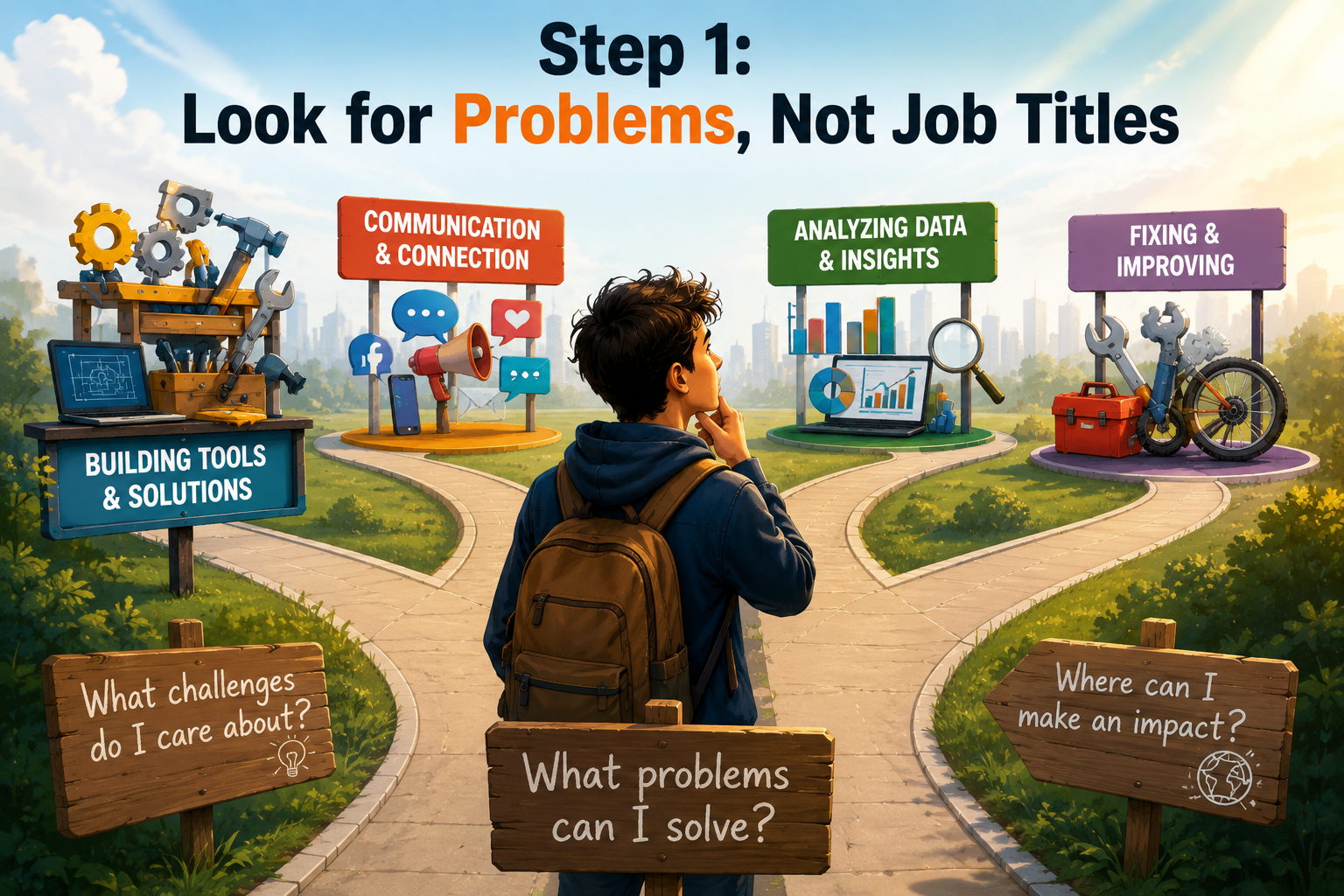
Step 1: Look for Problems, Not Job Titles
The traditional career advice asks: "What do you want to be?"
The Anti-Passion Approach asks: "What kinds of problems do you enjoy solving?"
The world doesn't pay people just to exist and be passionate; the world pays people to solve problems. Every single job on the planet is just a solution to a problem.
- Ubersolved the problem of getting a ride without waving down a taxi.
- Graphic designerssolve the problem of a business looking boring or confusing to customers.
- Therapistssolve the problem of people struggling to navigate emotional distress.
To find your starting point, think about the types of problems that naturally draw your attention. Do you like fixing things that are broken? Do you like organizing chaotic situations? Do you like making people laugh or feel less alone?
The Four Problem-Solving Categories
Most careers fall into one of four broad buckets of problem-solving. Which one sounds least like a chore to you?
| Category | The Core Focus | Example Fields |
|---|---|---|
| The Builders | People who like creating physical or digital things from scratch. | DSoftware engineering, construction, architecture, content creation. |
| The Fixers | People who look at something broken or inefficient and want to repair it. | Cybersecurity, medicine, automotive tech, financial auditing. |
| The Storytellers | People who love communicating ideas, emotions, or information. | Marketing, journalism, teaching, filmmaking, public relations. |
| The Analysts | People who love organizing data, finding patterns, and solving puzzles. | Data science, research, logistics, financial planning, forensics. |
By focusing on a category of problem-solving rather than a strict job title, you keep your options wide open. If you know you are a "Storyteller," you don't have to panic about whether you want to be a novelist or a marketing director yet. You just know your general direction.

Step 2: Conduct "Low-Stakes Career Test Drives"
You wouldn't buy a car without test-driving it first. You wouldn't buy an expensive pair of sneakers without trying them on. Yet, thousands of students commit to four years of expensive college tuition for a major they've never actually tried in real life.
If you don't know what you want to do, you need to sample different options through low-stakes, low-risk experiments.
[Standard Route] ──> Pick Major ──> Pay Tuition ──> Graduate ──> Realize you hate the actual job
[Anti-Passion] ──> Try 3-day project ──> Assess enjoyment ──> Pivot or double down early
Here is how you can "test drive" a career over a single weekend in high school:
1. The Virtual Shadowing Hack
You don’t need to land a formal corporate internship to see what a job looks like. Use YouTube, TikTok, and platforms like LinkedIn. Search for "Day in the Life of a UX Designer" or "Day in the Life of a Chemical Engineer." Look for the videos that show the mundane, boring parts of the day not just the highlighted reels. If their average, boring day looks acceptable to you, keep that career on your radar.
2. Micro-Projects
Want to see if you actually like graphic design? Don’t wait for a college class. Go onto Canva or Figma this weekend and design a fake rebrand for your favourite local coffee shop. Want to see if you like data analysis? Download a free public dataset about your favourite sport or video game and try to find trends using Google Sheets. If you get completely bored after twenty minutes, that's incredibly valuable data! You just saved yourself years of moving down the wrong path.
3. Informational Interviewing
Find someone who works in a field that sounds mildly interesting to you. It could be a friend’s parent, a local business owner, or an alumnus from your high school. Send them a polite message: "Hi, I'm a junior at X High School. I'm trying to figure out my next steps and your career looks really interesting. Do you have 15 minutes for a quick Zoom call so I can ask you three questions about what you do?" Most adults are incredibly flattered by this and will happily say yes.

Step 3: Build a "Skills Stack" Instead of a Specialist Map
In the past, the goal was to become an absolute specialist in one thing. You became an accountant, and you did accounting tasks for forty years.
Today, the most successful and resilient people build a Skills Stack. A skills stack is a combination of different skills that make you uniquely valuable, even if you aren't the absolute best in the world at any single one of them.
The Power of the Stack: Being a decent writer is good. Being a decent video editor is good. Being a decent data analyst is good. But if you combine all three? Suddenly, you are the ultimate modern digital marketer who can script, produce, and optimize content using real data.
While you are in Grades 9–12, stop stressing about picking your final destination. Instead, focus on gathering transferable skills that are valuable in every single industry. These are universal power-ups:
- Clear Writing: Can you explain a complex idea in a simple email?
- Basic Tech & Data Literacy: Can you navigate spreadsheets and understand basic data inputs?
- Project Management: Can you take a big, messy goal (like planning a school event) and break it down into small, organized steps?
- Public Speaking/Persuasion: Can you pitch an idea to a small group of people without freezing up?
If you enter your twenties with a strong stack of foundational skills, it doesn't matter what the economy or AI does. You will be adaptable enough to slide into whatever opportunity presents itself.
Your Action Plan for This Week
If the question "What's your passion?" makes you freeze up, give yourself permission to stop looking for it. Your career path isn't a straight line that you discover; it’s a trail that you hack out of the wood’s day by day through trial and error.
Here is your assignment for the next seven days to take the pressure off:
- Drop the word "Dream Job" from your vocabulary.Replace it with "Next Step."
- Pick one industry or topic you know absolutely nothing about, and spend 20 minutes watching an introductory documentary or "Day in the Life" video about it.
- Identify your primary problem-solving style. Are you a Builder, a Fixer, a Storyteller, or an Analyst?
Take a deep breath. You don't have to have your entire life figured out by graduation. Focus on being curious, learning how to solve interesting problems, and building a toolkit of skills. The rest will handle itself.
